
You Can Build the Wrong Life One Good Decision at a Time
Before you build an audience, a business, or an income stream, make sure you're not building someone else's future.
Most people online already know enough to start building something meaningful.
The problem is that the internet trains people to mistake consuming for progress.
The Psychology of Digital Builders explores how digital builders can create more, think more clearly, and spend less time mentally drifting online.
Most people never consciously decide what they want.
They inherit it.
A creator they admire.
A business model they discover.
A lifestyle they see online.
A version of success they spend enough time around.
Eventually, the desire feels personal.
That’s what makes it dangerous.
Because by the time you’re pursuing it, it no longer feels like someone else’s ambition.
It feels like your own.
And if you’re a digital builder, that matters more than most people realize.
Because digital builders don’t just pursue desires.
They build around them.
They create content around them.
Build audiences around them.
Start businesses around them.
Spend years reinforcing them.
Which raises an uncomfortable question:
How much of the future you’re building did you actually choose?
Chasing The Next Breakthrough
Back in 2021, I restarted my entrepreneurial journey to earn an online living.
I first found out about it in 2018 when I Googled “how to make money online”.
But as I attempted it back then, I got scammed a couple times, once from a pretty reputable company as I see them again 8 years later.
That left a bad taste in my mouth and made me quit altogether.
This resulted in me job hopping from place to place until just after the pandemic.
My now wife got me into social media — that’s when I learned about the For You pages in socials.
Anyway, TikTok was pretty new and she got me into it.
I saw a video of someone promoting a challenge that they used to make money online.
So I checked it out.
But, as I’m sure most people do, I saw that I had to pay, and left the page — even though it was only $7 USD (US Dollars).
Looking back, it wasn’t really the $7. I just wasn’t convinced yet that this was a path for someone like me.
Maybe a month or two later, I saw someone else promoting the same challenge.
Whether it was because it was a few days before my 31st birthday, me realizing time is flying, pressure from the need to provide... or maybe a combination of them all...
But something made me invest in the $7 USD.
Whatever it was, the urgency felt incredibly real.
I took the challenge and during the challenge, they were promoting a more comprehensive, more coaching help, program.
This program was a siginificantly bigger investment.
It was $2,500 USD.
As I’m from Canada, this came up to just under $3,200 CAD (Canadian Dolalars).
Well, I discussed it with my partner because it was such a big investment... and it was a large chunk of my saved money.
She had faith in me that I could make it work, and so I made the investment.
I took it very seriously.
I did everything they told me I had to do.
At the time, I thought certainty lived in following someone else’s blueprint perfectly.
They were essentially teaching how to do affiliate marketing, coaching and consulting, digital products, and events and masterminds.
But the main part of the program was the affiliate marketing.
And to promote, they were teaching how to go viral on TikTok.
Affiliate marketing is basically promoting other people’s products and when someone buys, you get paid a commission — usually anywhere between 40% to as high as 85% for the good ones.
You’re essentially getting paid to recommend products.
It was slow at first.
And when I say “slow,” I mean, I didn’t see any results after like a week.
Obviously, back then, my timeline of success was just horrible...
And as most programs are, they didn’t help make it any better.
They didn’t set my expectations or talk about the AVERAGE person’s results.
I mean, I’m sure if they did that, nobody would get the program.
But anyway... I stuck with it.
And in my 3rd week with the program, one of my TikTok videos blew up, I got like 20k followers, and I made my first commission of $22!
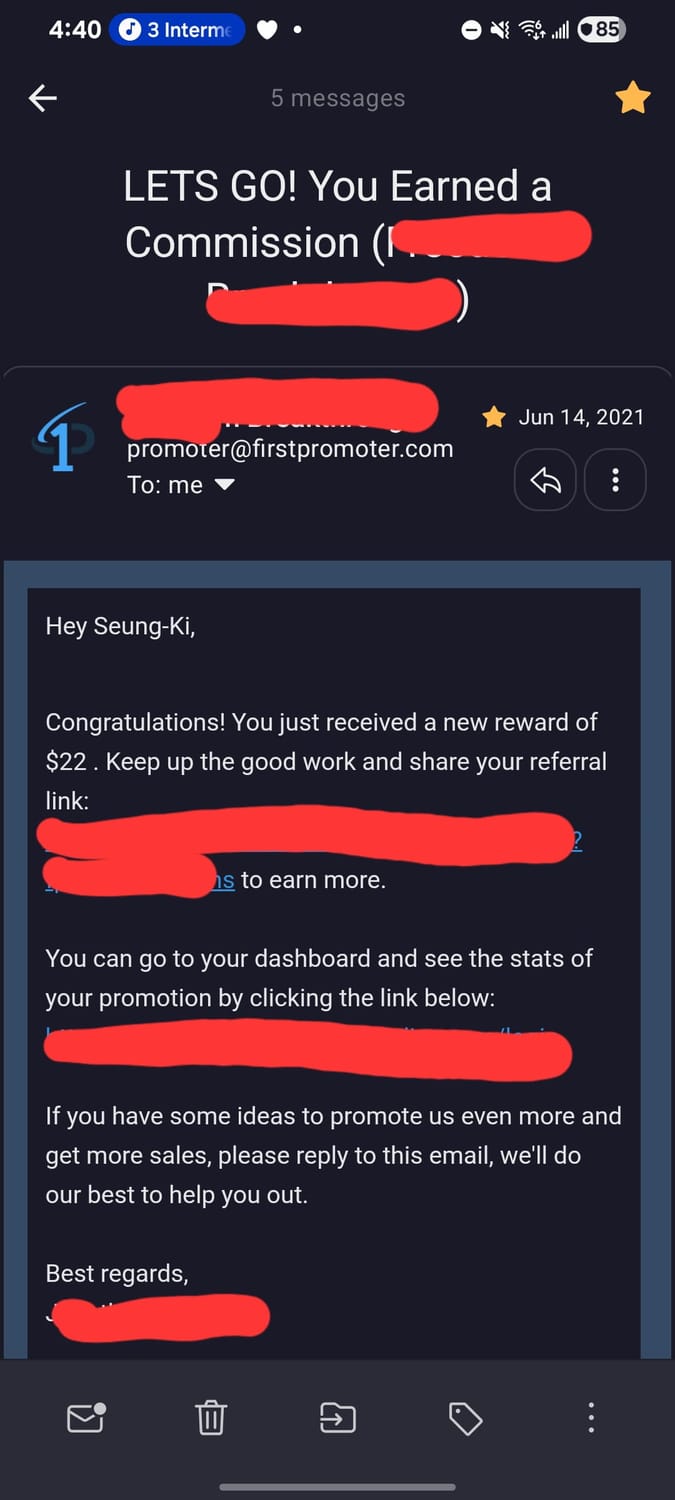
It wasn’t the money that hooked me. It was what the money seemed to prove.
That was one of the most exciting, and one of the worst things that could’ve happened to me on my journey.
But that’s a whole n’other story.
But as the weeks past after that, I was getting more commissions, little by little.
But these commissions were small commissions: $3 here, $18 there, more $3 commissions everywhere...
And to be honest, I probably wasn’t as grateful as I should’ve been, realizing this 5 years later...
But the thing was, I wasn’t getting the BIG money...
…the $1,000 commissions that so many in the program I saw were getting... multiple times...
My results stopped feeling impressive the moment I compared them to someone else’s.
I got fed up.
And the fact that I had to constantly “perform” in front of a camera every day didn’t help.
I felt like a dancing monkey.
I can only imagine this is probably how Steve Rogers felt in Captain America: The First Avenger.

The weird part is that I still wanted the outcome. I just hated the version of me I felt I had to become to get it.
Maybe I shouldn’t have had that mindset of making short-form videos, but that’s just how it felt for me.
And who knows… maybe in the future, if I see it a different way, I may go back to it.
Well, the next 5 years was just shit.
I was jumping from one business model to the next.
Every new opportunity felt like it might finally be the one.
The same affiliate marketing program, on top of teaching how to promote using TikTok, also taught how to promote using Facebook Ads.
So I saw how it was done.
I went from Facebook Ads, to Microsoft Ads, to Google Ads, to affiliate marketing, to CPA marketing, to trying to start a lead generation agency, to trying to start a freelance CMO (Chief Marketing Officer) agency, to trying to start a Social Media Marketing agency...
Each new thing, I saw someone doing it and watched how they did it.
There came a point were I was fed up again.
The things I was attempting was barely making me any money.
There was a point where I was making maybe a solid $1,000 for a few months consistently running Microsoft Ads.
But that came to a stop when my laptop got hacked and the hacker broke into my Microsoft Ads account and tried to... I guess promote malware or some virus shit?
But Microsoft banned my account.
I kept trying to tell them that my laptop got hacked and that a hacker was doing all that.
But somehow, one of the biggest computer companies didn’t understand what I was trying to tell them.
Anyway... some of the other things I tried were making me very little money.
Like a few hundred bucks a month.
And I just gave up and caved…
I thought to myself “You know what? I took for granted the money I was making with that $2,500 program. Maybe I should do it again but actually work my way up.”
So I went back to creating videos on TikTok.
Only, I wasn’t doing what I did before.
Before, what they told me to do was model the viral videos.
Not copy… model.
That had a high chance that your video would go viral as well.
But this time, they had a new CMO or whoever was hosting the live coaching.
They had a few coaches.
And they weren’t teaching that anymore.
They were teaching something else.
Well, I tried it their way.
For maybe 2-3 months.
And after all that, I got like 52 followers.
Compared to my first try and getting 20k followers, I was definitely bummed out.
Then on the coaching calls, I noticed that there were A LOT of others in my same position.
Some have been trying for even longer than me and were going nowhere with their videos.
This made me less motivated to continue on.
Then I found another method.
This time it was affiliate marketing but with YouTube Ads.
Some guy was teaching how to do it and I watched how he did it.
I attempted this method.
I tried for months to make it work.
And each week, it felt like I was getting closer and closer to finding my winning ad.
And because it felt close, quitting felt irrational.
This was causing me to lose money every month.
A few hundred bucks every month in ad costs.
And I wasn’t earning anything back.
I didn’t make a single sale!
I told my now wife, who was my girlfriend at the time, that I would stop in March if I didn’t find my winning ad yet.
Of course, March came... and went... and I was still trying.
It kept feeling like I was getting closer.
Until I found a completely new way of making money at the end of June.
It had nothing to do with marketing at all.
Essentially, I was a middleman for international businesses who needed buyers or suppliers of whatever product you can imagine.
I was the connector.
The person who introduced the buyer or supplier to each other and I would get paid a handsome commission.
My mentor showed me how to do everything from start to finish.
And if I ever had any questions, I would just message him.
Seriously, this was like nothing I’ve ever seen before.
There was the potential of earning MILLIONS of dollars EVERY MONTH!
The bigger the opportunity sounded, the harder it became to think about anything else.
I came close to closing a deal where I was supposed to get paid $2M every month for a year, and possibly longer if the buyer extended the contract.
You can see why I tried to make this my sole business model and tried to make it work for almost a year and a half.
At the end of that, I attempted to make YouTube Ads work again.
But it wasn’t the same as it was before.
After that, I tried to get back into the international trading and sourcing thing...
But it wasn’t the same either.
One of the biggest reasons I stopped it was because the industry is like 90% scammers.
And I was getting sick of every day finding out the person I was talking to was just another scammer.
It was around this time I realized something that took me almost 5 years to realize...
Any one of those methods I attempted, would’ve worked...
...if I gave it enough time to.
The problem wasn’t that I kept choosing bad opportunities.
But I realized, I would try something for a month maybe two... at longest a year and a half for one case...
And then I’d move onto the next thing.
The next promise of blowing up.
The next promise of hitting my breakthrough.
Every path looked convincing while I was standing in front of it.
I was essentially just chasing a high.
At the time, I thought I was chasing success.
But I also realized something else...
I HAD to try all these different things...
To know what it was I eventually would settle on for the rest of my life.
Once I figured that out, it was a matter of sticking with it for as long as I have to, to make it work.
The Problem Wasn’t Motivation. It Was Ownership.
For years, I thought my problem was commitment.
I thought I was impatient.
Undisciplined.
Always chasing the next shiny object.
And to be fair, that’s what it looked like from the outside.
I’d find a new opportunity.
Get excited.
Throw myself into it.
Then eventually lose interest and move onto something else.
Over and over again.
But eventually I realized something:
I wasn’t struggling to pursue what I wanted.
I was struggling to determine whether what I wanted was actually mine.
That’s a very different problem.
Because when a desire feels like yours, you’ll sacrifice for it.
You’ll endure uncertainty for it.
You’ll keep showing up long after the excitement disappears.
But when a desire was borrowed from somewhere else...
…commitment starts feeling a lot harder.
1. Mimetic Desire (When Other People’s Goals Start Feeling Like Your Own)
One of the most uncomfortable realizations I’ve had is that we don’t arrive at many of our desires independently.
We absorb them.
We see someone living a certain lifestyle.
Building a certain business.
Making a certain amount of money.
Getting a certain result.
And somewhere along the way, our brain quietly starts saying:
“Maybe I want that too.”
The strange part is that it doesn’t feel borrowed.
It feels personal.
It feels like your own ambition.
It’s kinda like when I made that first $22 commission.
The money itself wasn’t life-changing.
But what it represented was.
For the first time, there was evidence that this entire world might be available to me too.
Then later, when I started obsessing over the people earning $1,000 commissions, my attention shifted.
The goalposts moved.
Suddenly my progress didn’t feel impressive anymore.
Not because my results changed.
Because the people I was comparing myself to changed.
Borrowed Importance:
The more attention we give something, the more significant it begins to feel.
Repeated exposure slowly transforms possibilities into preferences.
Social Proof Contagion:
When enough people appear to value something, our brain starts treating that thing as valuable before we’ve fully evaluated it ourselves.
Desire Adoption:
Many ambitions enter through observation long before they enter through conscious choice.
The problem isn’t that we imitate.
Humans are supposed to imitate.
The problem is when we stop questioning what we’ve inherited.
2. Conformity Bias (Why Success Starts Feeling Smaller Around Successful People)
One of the reasons I kept abandoning things wasn’t because the opportunities stopped working.
It was because my standards kept changing.
Every room I entered came with a new definition of success.
One group was making affiliate commissions.
Another was building agencies.
Another was running ads.
Another was sourcing international deals.
Every environment had its own scoreboard.
And every time I entered a new environment, I started measuring myself against a different one.
It’s kinda like when those early commissions stopped feeling exciting because other people were posting screenshots of commissions that were fifty times larger.
Objectively, I was making progress.
Subjectively, it felt like I was falling behind.
Relative Success:
People naturally evaluate progress against nearby examples rather than objective reality.
Environmental Standards:
The people around you quietly determine what feels impressive, normal, or disappointing.
Comparison Distortion:
Growth can feel like failure when comparison scales faster than progress.
No wonder so many digital builders feel scattered.
The internet doesn’t expose you to one tribe.
It exposes you to thousands.
And every one of them is trying to convince you that their path is the path.
3. Self-Determination Theory (Why Some Goals Create Energy And Others Drain It)
This was the realization that explained why I kept feeling pulled in two directions.
I wanted the outcome.
But I didn’t always want the process.
That’s not the same thing.
It’s kinda like when I said creating TikTok videos made me feel like a dancing monkey.
I still wanted the money.
I still wanted the freedom.
I still wanted the result.
But I hated who I felt I had to become to get there.
A goal can look attractive from the outside while quietly violating something important on the inside.
And when that happens, motivation becomes unstable.
Autonomy:
People sustain effort longer when they feel they are choosing the path rather than complying with it.
Identity Congruence:
The closer a goal aligns with who you naturally want to become, the easier it becomes to remain committed during difficult periods.
Internal Ownership:
Motivation becomes more durable when the desire survives external validation, status, and comparison.
A lot of digital builders think they’re struggling with discipline.
Sometimes they’re actually struggling with misalignment.
They’re trying to force long-term commitment toward goals that never fully belonged to them.
4. The Desire Consumer vs The Desire Architect
This is the distinction that changed everything for me.
A Desire Consumer absorbs ambitions.
A Desire Architect evaluates them.
A Desire Consumer sees a lifestyle and asks:
“How do I get that?”
A Desire Architect asks:
“Why do I want that?”
A Desire Consumer collects possibilities.
A Desire Architect chooses priorities.
It’s kinda like those five years where every opportunity felt like it might finally be the breakthrough.
Facebook Ads.
Google Ads.
Agencies.
Affiliate marketing.
International sourcing.
Every path looked convincing while I was standing in front of it.
And that’s because attractive opportunities aren’t rare.
They’re everywhere.
The internet manufactures them all day long.
The real skill isn’t finding attractive opportunities.
The real skill is deciding which ones deserve your life.
Exposure Inflation:
The more time spent around an idea, the more natural it begins to feel.
Decision Ownership:
Commitment becomes easier when a goal has been consciously chosen rather than unconsciously inherited.
Builder Compounding:
Long-term leverage comes from staying with a direction long enough for effort to compound.
Most people think they’re trying to build a business.
Or an audience.
Or an income stream.
A lot of the time they’re actually trying to answer a deeper question:
“Which of these desires are genuinely mine?”
Because once that becomes clear...
…commitment stops feeling like force.
It starts feeling like alignment.
The Desire Inheritance Cycle
Most builders think desire starts with choice.
It doesn’t.
Most desire starts with exposure.
You see something enough times.
You admire it.
You imagine yourself having it.
Then eventually, without realizing it, you start treating it like your goal.
That’s the dangerous part.
Because the desire feels personal by the time you pursue it.
But it may have started somewhere else entirely.
This is the cycle:
Exposure → Admiration → Adoption → Pursuit → Friction → Audit → Ownership
1. Exposure
This is where the desire first enters your world.
A video.
A creator.
A revenue screenshot.
A lifestyle.
A business model.
A group of people all chasing the same thing.
Kinda like when I kept seeing people promote that same $7 challenge.
At first, I ignored it.
Then I saw it again.
And eventually, it didn’t feel random anymore.
It felt like a possibility.
2. Admiration
Exposure becomes admiration when the goal starts looking attractive.
Not because you’ve evaluated it.
Because someone else made it look desirable.
Kinda like seeing people in the program getting $1,000 commissions.
Suddenly, my $22 commission didn’t feel like evidence anymore.
It felt small.
Because admiration changed the scoreboard.
3. Adoption
This is where the desire becomes dangerous.
Because you stop thinking:
“That looks interesting.”
And start thinking:
“I want that.”
The desire becomes internal.
It feels like yours.
Kinda like when every new business model felt like it might finally be the one.
Affiliate marketing.
Ads.
Agencies.
International sourcing.
Each one felt convincing while I was standing in front of it.
4. Pursuit
Once the desire becomes yours, your life starts organizing around it.
Your time.
Your attention.
Your content.
Your learning.
Your identity.
This is when builders start optimizing execution before questioning direction.
They ask:
“How do I make this work?”
Before asking:
“Why do I want this in the first place?”
5. Friction
This is where the borrowed desire starts revealing itself.
Motivation fades.
Consistency weakens.
The work starts feeling heavier than it should.
Kinda like when I was doing the international trading and sourcing thing and I wanted to put a pause on it because of all the scammers.
You get attracted to other paths.
You start wondering if you chose the wrong thing.
But the real issue might be deeper.
The problem may not be the method.
The problem may be ownership.
6. Audit
This is the interruption point.
The moment you stop obeying the desire long enough to question it.
Ask:
Where did this desire come from?
Who made this look valuable to me?
Would I still want this privately?
Would I want this without status?
Does pursuing this create energy… or just admiration?
Can I imagine doing this for years?
Does this support the future I actually want to build?
This is where a builder becomes dangerous in a good way.
Because now they’re not just consuming ambitions.
They’re evaluating them.
7. Ownership
Only examined desires can become self-authored desires.
Not every inherited desire needs to be discarded.
Some borrowed desires become real after examination.
But they have to survive the audit first.
That’s the difference.
A Desire Consumer absorbs.
A Desire Architect selects.
And once a desire is selected consciously, commitment becomes cleaner.
Because you’re no longer forcing yourself to build toward someone else’s future.
You’re choosing the future you’re willing to keep building when the dopamine wears off.
The Future You’re Reinforcing
Most people inherit desires.
Digital builders do something more dangerous.
They build around them.
That’s what kept hitting me as I reflected on those 5 years.
The problem wasn’t that I kept finding opportunities.
The internet is full of opportunities.
The problem wasn’t even that those opportunities were bad.
Many of them probably would’ve worked.
The problem was that I kept pursuing them before I understood why I wanted them in the first place.
And that’s a much bigger problem for builders than it is for everyone else.
Because builders don’t just pursue desires.
They reinforce them.
Every newsletter you write.
Every audience you build.
Every offer you create.
Every business model you pursue.
Every asset you spend years developing.
All of it strengthens a particular future.
Kinda like when I kept moving from one opportunity to another.
At the time, each one felt important.
Each one felt worthy of my attention.
Each one felt like the future I should be building toward.
But I rarely stopped long enough to ask where that desire came from.
Whether it was actually mine.
Or whether I had simply spent enough time around people who made it look valuable.
That’s the fork in the road.
You can continue letting:
creators
algorithms
trends
revenue screenshots
business models
online environments
decide what deserves your attention.
And if you do, you’ll probably keep building.
You’ll keep learning.
You’ll keep creating.
You’ll keep pursuing opportunities.
But there’s a good chance you’ll be building toward a future you never consciously chose.
Or...
You can become the architect of your desires.
You can decide:
what deserves pursuit
what deserves your attention
what future is worth building toward
And then use your time, knowledge, skills, content, audiences, offers, and assets to reinforce that future intentionally.
Because that’s the real responsibility that comes with being a digital builder.
Not simply creating things.
Choosing what those creations are helping you become.
The internet will never stop offering you futures.
The question is:
Which one are you helping build every time you sit down to create?
Build something meaningful instead of spending years consuming. Join digital builders building more intentionally online.
Stay in touch
I write occasionally, when something feels worth sharing.
Occasionally, I write something worth sending. No noise.